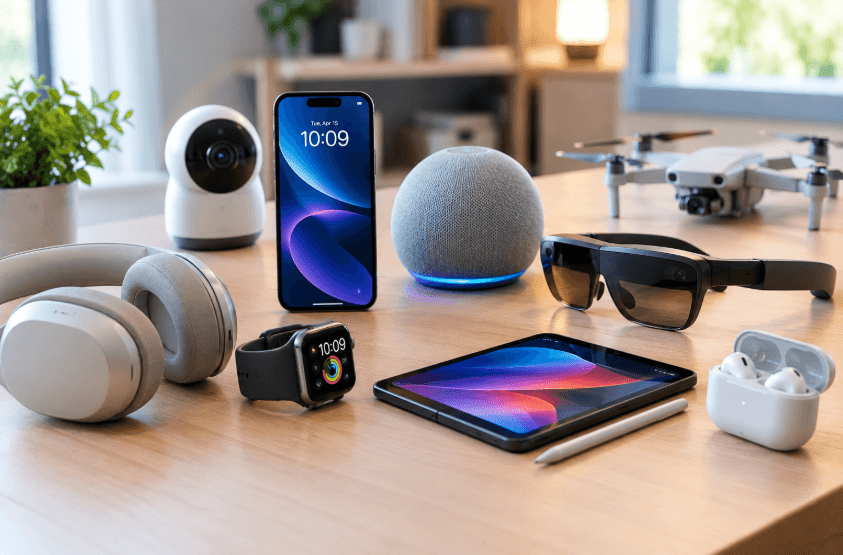
Consumer technology has crossed a major threshold. For years, innovation was measured in incremental steps: slightly thinner bezels, incremental processor updates, and higher megapixel counts. Moving into 2027, hardware evolution will be defined by ambient intelligence, context-aware spatial computing, and fundamental shifts in form factor.
From display-less smart wearables to self-sustaining home power systems, this year’s standout devices shift focus away from screens toward seamless integration with the physical world.
Ambient AI & Next-Gen Smart Wearables
Wearables are ditching visual notifications in favor of hands-free context. Powered by highly efficient on-device neural processing units (NPUs), 2027’s smart wearables will listen, sense, and assist in real time.
- No-Display AI Glasses: Lightweight smart glasses have become a dominant daily accessory. Dropping bulky heads-up displays, these frames use open-ear directional audio, micro-cameras, and conversational AI models to act as context-aware co-pilots—translating conversations in real time and offering navigation overlays without cluttering your view.
- Biometric & Stress Assistants: Wearables are moving past passive fitness tracking into active health management. Modern smart rings and lapel pins now continuously track skin temperature shifts and glucose indicators, suggesting proactive hydration or stress-relief protocols before physical exhaustion hits.
Flexible Form Factors & Spatial Computing
Computing hardware continues to move away from rigid clamshells, adopting adaptable physical designs that flex around user workflows.
- Tactile Haptic Wearables & Air-Input: Displays are being paired with advanced micro-haptic gloves and rings that allow users to feel digital interfaces, enabling natural “air typing” and tactile manipulation of virtual objects.
- Foldable-to-Wearable Form Factors: Mobile displays have reached new levels of durability. Devices featuring ultra-thin, nearly indestructible rollable screens can transform from a standard pocket-sized smartphone into an immersive tablet—or wrap around the wrist as a wearable smart display.
On-Device AI Content Creation Rigs
Content creation tools are prioritizing real-time processing and dual-capture capabilities to eliminate post-production friction.
- Dual-Aspect Cinema Recorders: Hardware accessories now capture high-dynamic-range horizontal footage for desktop screens and vertical footage for mobile platforms simultaneously through a single lens array, saving creators hours in post-production.
- Generative Audio Rigs: Compact field recorders come equipped with local AI processors capable of isolating voices, removing background noise, and balancing multitrack audio live without sending data to cloud servers.
How to Choose Your Next Tech Upgrade
When evaluating 2027’s tech landscape vs new gadgets 2026, make sure to analyze their processing capabilities. Devices processing AI models locally offer much lower latency and significantly better privacy protection than cloud-dependent alternatives.
Likewise, prioritize functional elegance over feature bloat. Look for gadgets built around a single, highly refined workflow rather than complex multi-tools that add unnecessary UI friction. Repairability is another factor to keep an eye on. Prioritize hardware manufactured with modular components, standardized screws, and guaranteed long-term firmware support.